





Session: AO.015 
 Age: 12-Adlt |
 Intensity: Medium |
 Time: 25 mins |
 Positions: 2,3,4,5,6 |
 Players: 10+ |
 Area: 60x45 yrds |
Exercise Objectives
- To train the ability to attack down the flanks.
Organisation
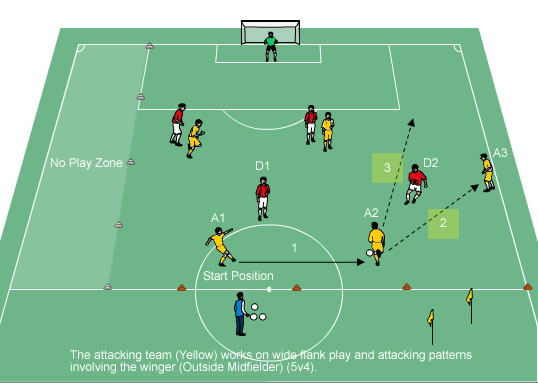
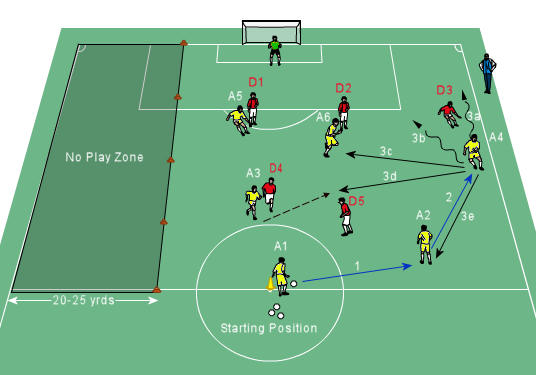
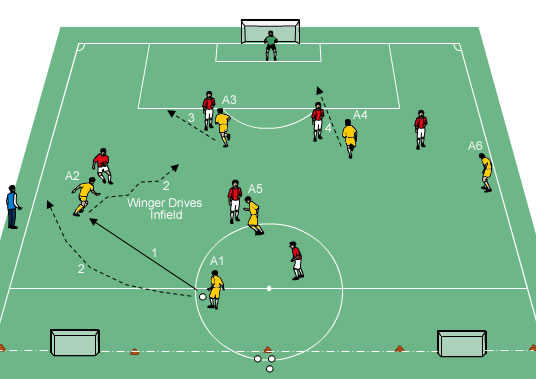
Diagram 1. Set-Up Arrangement
Set-Up
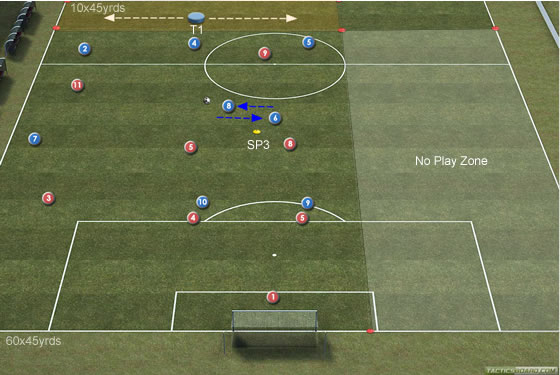
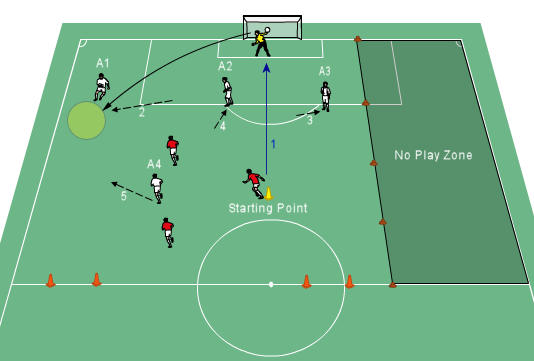
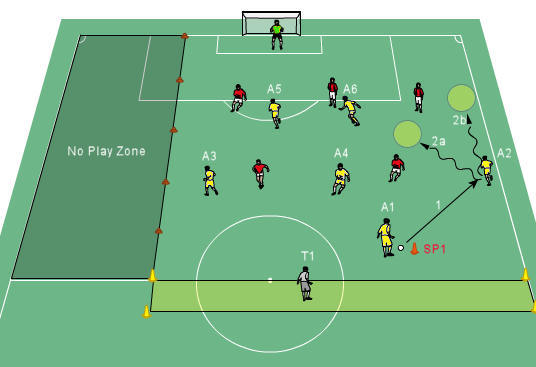
- Mark out a half pitch area and a 'no play zone' on one side of the pitch. A 5 yrd gate is placed at an angle behind the half way line, preferably using training poles or flags. Keep a collection of balls at the half way line for re-starts. In the example above the yellow attacking team combines with each other using the flank player to create opportunities on goal. Switch the roles of attacking and defending after 10 minutes. The restart positions can be varied as shown in the progression. The coach works with the attacking team to identify the key points of attacking down the flanks.
- 5 attackers (Yellow)
- 4 defenders (Orange)
- 1 goalkeeper (Green)
Start Position(s)
- The center midfielder (A1) gathers a ball unopposed and passes to the other center midfielder with a square pass, the game is now live.
- A2 looks up and sees the wide players (A3) open and passes to him.
- A2 recognizes a gap behind D2 and makes a run into the space where he can receive a pass back from A3.
Scoring
- 2 teams compete and attempt to score.
- The attacking team scores by scoring on the goal.
- The defending team scores by clearing the ball out through the yellow pole gate.
Coaching Points
- Observe the movement of the wide player (A3) to create angles and find space and create width.
- Look for space in front and behind the defenders on the wing.
- Check away from the space you want to create and then sprint into it.
- Wide player should receive facing into the field and with attacking mentality (attack and dribble or forward pass).
- Encourage support runs from other attacking players.
- Forwards making runs clear paths and space for supporting players or the player on the ball.
- Encourage players to dribble and penetrate when they see space.
- Observe for the following attacking patterns shown in diagram 2.
A - Can the center midfielder drive into the space created by the wide player pulling out the defender?
B - Pass wide to give width to the attack?
C - Can the flank player drive inside OR pass inside to the near forward?
D - Drive down the line OR pass to the near forward making a run wide.
E - In the forward checks inside and takes the defender(s) inside can we drive down the line?
F - Can the flank player play a pass inside to the near forward as a wall pass and receive the ball back down the line (1-2).
There are many more patterns which you should explore, these are just a sample to give you ideas.
 Darren Pitfield
 Alexander Trukan