






Session: AO.083 
 Age: 12-Adlt |
 Intensity: Low |
 Time: 20 mins |
 Positions: All |
 Players: 8+GK |
 Area: 44x20 yrds |
Exercise Objectives
- Developing attacking heading technique.
- Develop runs to attack crosses.
- Develop crossing and finishing.
Organisation
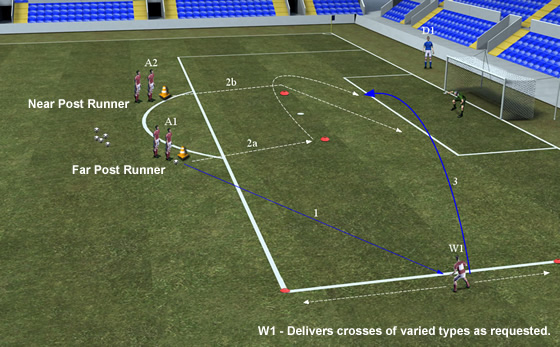
Diagram 1. Set-Up Arrangement
Set-Up
- 20x44 yrd area (roughly penalty area) with 1 full size goals.
- Finishers are lined up behind a near and far post starting cone and either one or two players positioned to distribute crosses.
- Balls should be placed with the finishers.
- 2 cones are placed aside the penalty spot to give guides to the two runners.
Instructions
- The attackers go in twos and attempt to finish an aerial crossed ball (either thrown in by hand or by feet) on goal.
- A1 (Far Post Runner) passes a ball out to the wing player.
- a) A1 runs into the cone in front of them before looping back and round (Horse Shoe Run) the other cone before running in at the back post. b) A2 (Near post runner) runs to the cone in front of them and then cuts diagonally at the near post (arriving slightly before the far post runner in the second 6 yrd area).
- W1 on receiving the ball take a touch (or two) down the line and delivers in a cross (the type of cross is requested by the coach).
- Player D1 waits and helps return balls to the attacking lines until the progressions.
Scoring
- 1 goal = Scoring on the full size goal normal.
Coaching Points
- Get in line with the flight of the ball.
- On your toes to do this (shuffle steps).
- Keep your eyes on the ball until impact.
- Keep the neck stiff, and use the waist/back to move the head toward the ball.
- Eyes OPEN!, Mouth CLOSED!
- Contact should be made with the center of the forehead.
- Attacking headers should be directed down towards the goal keepers feet.
- If you hit the ball on its bottom half, the ball will go up. If you hit the ball on the upper half, the ball will go down.
- To generate power and distance arch the back.
- Extend your neck. The power of a header does not come from your neck muscles. Bend back your entire upper body and then lunge forward to strike the ball.
- Keep your shoulders leveled and perpendicular to your aim.
- Arms out for balance and protection from other players in heading aerial challenges.
- Aim to be physical and get in front of the defender.
- Time attacking runs, don't arrive to early and be waiting on the ball where you would loose momentum.
- Follow up rebounds.
- Near post players should spin out to receive knock downs when the ball is played to the far post runner.
Progressions
- The additional of a passive defender who shadows one of the attacking runners. The coach can request either the near or far post runner to be shadowed if desired. (Diagram 2)
- 2 passive defenders now defend each shadowing one of the attacking runners. (Diagram 3)
- The passive defenders become active defenders attempting to clear the ball.
- Remove the cones guiding in the players attacking runs.
- Thrown delivery of crosses can be progressed to crosses delivered with the feet.

Diagram 2. Additional of a Passive Defender

Diagram 3. Additional of 2 Passive Defenders
Variations
- Delivery of crosses from the opposite side of the field.
- Deliver different types of crosses (i.e. in swinging, floated, driven, etc)
 Darren Pitfield
 TonyDeers
