
| Injury Description | |||
|
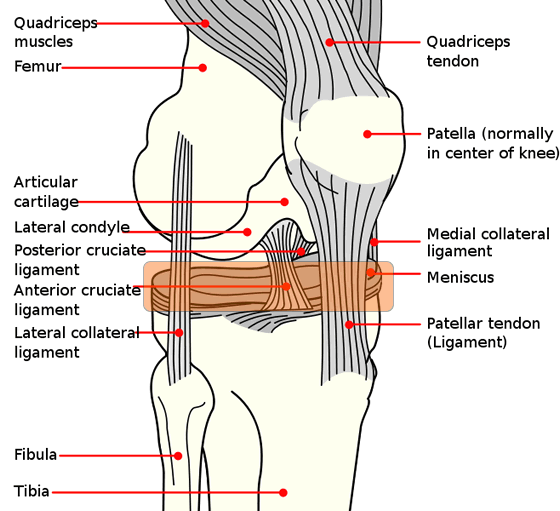
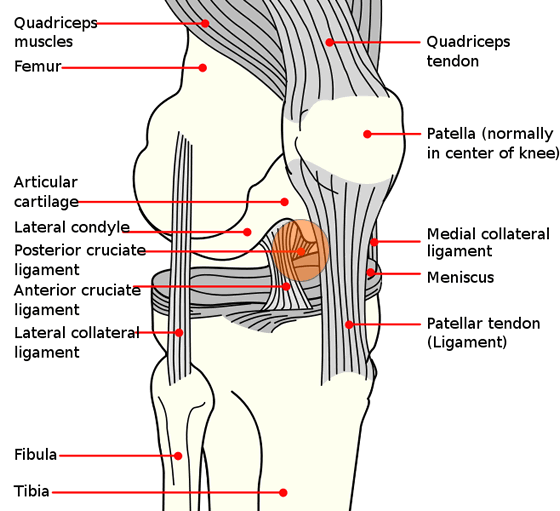
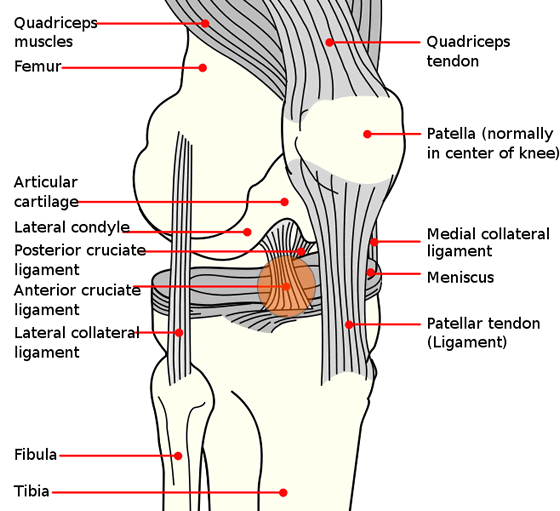
The posterior cruciate ligament (or PCL) is one of the four major ligaments of the knee. It connects theposterior intercodylar area of the tibia to the medial condyle of the femur. This configuration allows the PCL to resist forces pushing the tibia posteriorly relative to the femur. In the quadruped stifle (analogous to the human knee), based on its anatomical position, it is referred to as the caudal cruciate ligament.[1] The PCL is an intracapsular ligament along with the anterior cruciate ligament (ACL) because it lies deep within the knee joint. They are both isolated from the fluid-filled synovial cavity, with the synovial membrane wrapped around them. The PCL gets its name by attaching to the posterior portion of the tibia.[2] |
|||
 |
|||
| Signs and Symptoms | |||
| Pain at the time of impact which dies away afterwards. Swelling. If the swelling comes on rapidly then it could be caused by bleeding within the joint. In the later stages when the swelling has decreased there may be instability in the joint. Pain when the posterior cruciate ligament is stressed by gently bending it the wrong way (see opposite). | |||
| Causes | |||
|
The posterior cruciate ligament is injured through hyperextension of the knee or bending it backwards. If you have jarred the knee, or had someone land on top of a straight leg then the posterior cruciate may be damaged. If you have injured the joint recently and there is a lot of swelling then you should see a professional immediately. |
|||
| Treatment | |||
| The PCL does not heal on its own, so surgery is usually required in complete tears of the ligament. Surgery usually takes place after a few weeks, in order to allow swelling to decrease and regular motion to return to the knee. A procedure called ligament reconstruction is used to replace the torn PCL with a new ligament, which is usually a graft taken from the hamstring or Achilles tendon from a host cadaver. An arthroscope allows a complete evaluation of the entire knee joint, including the knee cap (patella), the cartilage surfaces, the meniscus, the ligaments (ACL & PCL), and the joint lining. Then, the new ligament is attached to the bone of the thigh and lower leg with screws to hold it in place.[7] |
|||
| Prevention | |||
|
Regular neuromuscular training that is designed to enhance proprioception, balance, proper movement patterns and muscle strength. |
|||
| References | |||
|
Posterior Cruciate Ligament Injury
- Details
- Parent Category: Soccer Injuries
- Category: Knee Injuries
 Darren Pitfield