
| Injury Description | |||
|
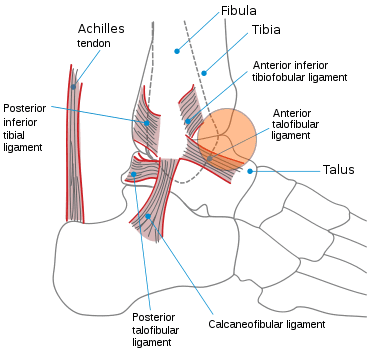
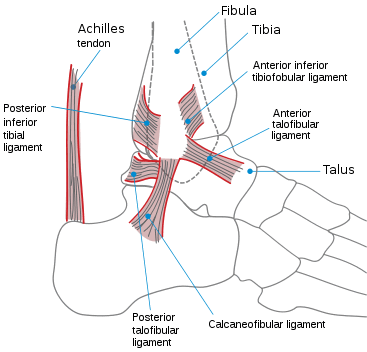
A sprained ankle, also known as an ankle sprain, twisted ankle, rolled ankle, ankle injury or ankle ligament injury, is a common medical condition where one or more of the ligaments of the ankle is torn or partially torn. Inversion (lateral) ankle sprainThe most common type of ankle sprain occurs when the foot is inverted too much, affecting the lateral side of the foot. When this type of ankle sprain happens, the outer, or lateral, ligaments are stretched too much. The anterior tabofibular ligament is one of the most commonly involved ligaments in this type of sprain. Approximately 90% of ankle sprains are inversion injuries. Eversion (medial) ankle sprainA less common type of ankle sprain is called an eversion injury, affecting the medial side of the foot. When this occurs, the medial, or deltoid, ligament is stretched too much. High ankle sprainA high ankle sprain is an injury to the large ligaments above the ankle that join together the two long bones of the lower leg, called the tibia and fibula. High ankle sprains commonly occur from a sudden and forceful outward twisting of the foot, which commonly occurs in contact and cutting sports such as football, rugby, ice hockey, basketball, volleyball, lacrosse, baseball, track, ultimate frisbee, soccer, and tennis. |
|||
 |
|||
| Signs and Symptoms | |||
|
Knowing the symptoms that can be experienced with a sprain is important in determining that the injury is not really a break in the bone. When a sprain occurs, blood vessels will leak fluid into the tissue that surrounds the joint. White blood cells responsible for inflammation migrate to the area, and blood flow increases as well.[4] Along with this inflammation, swelling from the fluid and pain is experienced. The nerves in the area become more sensitive when the injury is suffered, so pain is felt as throbbing and will worsen if there is pressure placed on the area. Warmth and redness are also seen as blood flow is increased. Also present is a decreased ability to move the joint, and difficulty using the affected leg. |
|||
| Causes | |||
|
Sprains happen when the foot is rolled or turned beyond motions that are considered normal for the ankle. An ankle sprain usually occurs when a person lands from jumping or running onto an uneven surface. If the ankle is placed into an abnormal position at the same time, overstretching of the ligaments can occur. The ligaments of the ankle hold the ankle bones and joint in position, and therefore help to stabilise the ankle joint. They protect the ankle joint from abnormal movements-especially twisting, turning, and rolling of the foot.[1] The risk of an ankle sprain is greatest during activities that involve explosive side-to-side motion, such as tennis or basketball. Sprained ankles can also occur during normal daily activities such as stepping off a curb or slipping on ice. Returning to activity before the ligaments have fully healed may cause them to heal in a stretched position, resulting in less stability at the ankle joint. This can lead to a condition known as Chronic Ankle Instability (CAI), and an increased risk of ankle sprains. The following factors can contribute to an increased risk of ankle sprains:
|
|||
| Treatment | |||
| If the ankle is not swollen, it just hurts to walk on and has limited mobilization, it is generally recommended that the injured wear an orthopedic walking boot for two weeks and be on crutches for the first week at least. Ice is often used to reduce swelling in cycles of 20-30 minutes on and 20-30 minutes off. Icing an ankle too long may cause cold injuries, indicated if the area turns white.[6] |
|||
| Prevention | |||
|
Regular neuromuscular training that is designed to enhance proprioception, balance, proper movement patterns and muscle strength. |
|||
| References | |||
|
Ankle Sprain
- Details
- Parent Category: Soccer Injuries
- Category: Ankle Injuries
 Darren Pitfield